The Conservation Amendment Bill is not about funding DOC. It is the corporate-state writing its mandate into law — and five million hectares of ancient forest just became a balance sheet item.
New Zealand · Conservation Amendment Bill · June 2026

To allow the market mechanism to be sole director of the fate of human beings and their natural environment, including the rate at which it is used up, would result in the demolition of society.”
— Karl Polanyi, The Great Transformation, 1944. Polanyi named land, labour and money as “fictitious commodities” — things the market treats as products but that cannot be manufactured for sale. Ancient New Zealand forest was not produced for market disposal. It accumulated over millennia as the common inheritance of every person who will ever live in this country. The Conservation Amendment Bill 2026 has decided that distinction does not matter.
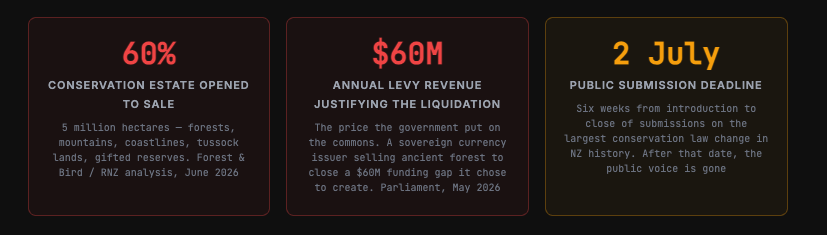
The government did not announce a conservation sell-off. It introduced a bill that rewrites the Conservation Act to make commercial exploitation DOC's primary legal purpose — then set a six-week submission window and called it consultation. Five million hectares. The Tararuas. Lewis Pass beech forest. The reserve containing Roys Peak. Land the public fundraised for and gifted to the Crown. All of it eligible. The urgency is not accidental.
What the Bill actually does
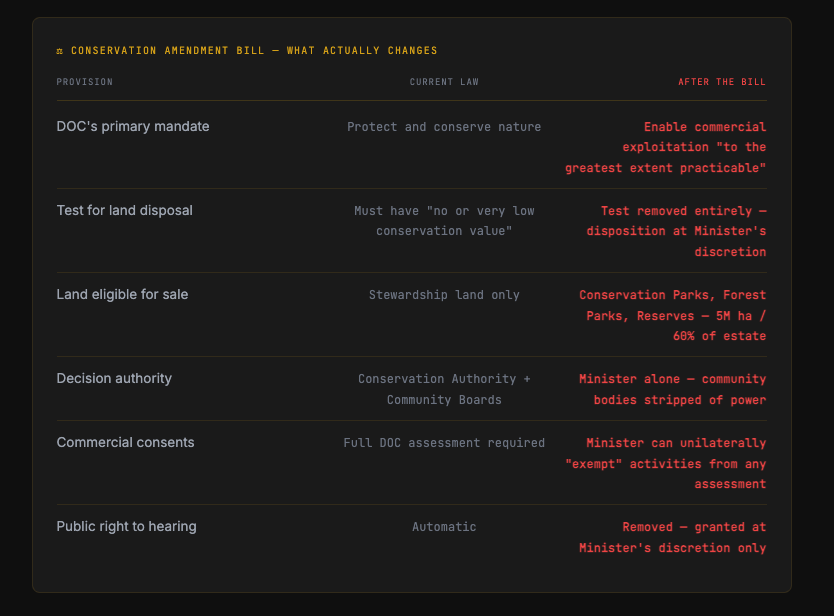
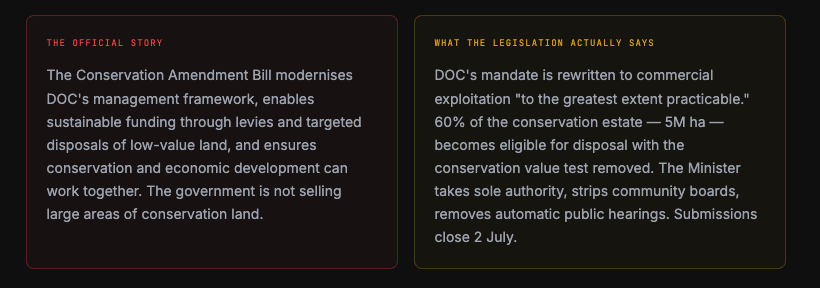
Conservation Minister Tama Potaka has said the government is not embarking on a programme of selling conservation land. The Bill says otherwise — not in tone, but in text. Under current law, DOC can only sell land once it has been assessed as having no or very low conservation value. The Conservation Amendment Bill removes that test entirely. It expands the categories of land eligible for disposal beyond stewardship land to include Conservation Parks, Forest Parks, and Reserves — provided they are not a National Park, a wilderness area, or one of a small number of named sanctuaries.
What that leaves on the table: the Tararua Forest Park. The Whirinaki. Mount Richmond. The Lewis Pass beech forest — ancient, irreplaceable, donated to the Crown through the Natural Heritage Fund by New Zealanders who raised the money to protect it. The Wānaka reserve containing Roys Peak. High-country tussock lands on the South Island’s east coast. Portions of Te Wāhipounamu, a UNESCO World Heritage site. Forest & Bird has produced maps of the affected land. They cover the country in red and orange. The scale is not a detail to be worked out later. It is the design.
Potaka’s office has not disputed the maps. His response is that the Bill “establishes a clearer framework for considering exchanges and disposals where doing so would improve conservation outcomes.” The Bill’s text establishes something rather more specific: DOC is now legally required to enable commercial exploitation “to the greatest extent practicable.” That phrase is not a carve-out or an exception. It is the new primary purpose of the Conservation Act itself.
The corporate-state move — written into the legislation
The Yarvin model of government — the state run as a corporation, citizens treated as customers, elected officials operating as CEOs cutting through democratic gridlock — does not usually arrive in a single piece of legislation. It accumulates: Fast-track approvals bypassing environmental review, KPIs replacing policy, quarterly reporting replacing public deliberation. The Conservation Amendment Bill is different. It writes the corporate mandate directly into the statute.
Three changes deserve to be read together. First: DOC’s foundational purpose is rewritten from protecting nature to enabling commercial exploitation to the greatest extent practicable. Second: decision-making authority is stripped from the Conservation Authority and Conservation Boards — the community bodies with independent experts and iwi representation — and vested in the Minister alone. The Minister can now unilaterally designate commercial activities as “exempt” from requiring consent, bypassing standard environmental safeguards entirely. Third: the automatic right to a public hearing is removed. If you wish to object to a commercial permission or a land disposal, your right to be heard is gone unless the Minister grants it.
This is not modernisation. It is the Yarvin sequence applied to the conservation estate: mandate rewritten to commercial purpose, community oversight stripped, democratic process removed, power centralised in the executive. The Fast-track Approvals Act already demonstrated the template. The Conservation Amendment Bill applies it to the last category of New Zealand land that has, until now, been held explicitly in trust for the public — not as a government asset, but as a commons.
The manufactured scarcity — and who made it
The government’s justification is that DOC needs sustainable funding. The Conservation Minister told Parliament that maintaining world-class conservation experiences “comes at a cost, and that cost should not be borne just by taxpayers.” The Bill proposes levies on international visitors — projected at $60 million per year — supplemented by revenue from land sales. This is the mechanism: a department that a sovereign currency issuer has chosen to underfund is now asked to monetise its own assets to survive.
New Zealand’s tourism industry generates approximately $17 billion annually — an industry built almost entirely on the conservation estate the Bill proposes to liquidate. The snow-covered mountains, ancient forests, wild rivers, and native birdsong that draw visitors from every country on earth are not incidental to the New Zealand economy. They are the product the economy sells. The government has decided that the department protecting that product cannot be funded by a currency-issuing state, and must instead be funded by selling the product itself. The logic requires a prior commitment to manufactured fiscal scarcity so absolute that no alternative is considered.
Karl Polanyi named what is happening here. Land is a fictitious commodity — it was not produced for market sale, cannot be reproduced if consumed, and derives its value from the collective activity of the society around it: the generations who protected it, the public investment that made it accessible, the conservation work funded by every taxpayer who ever paid tax in New Zealand. When the market takes ownership of that land, it does not acquire something the seller produced. It acquires something the commons built. The price paid at disposal captures none of that history. The loss at disposal is permanent.
“A sovereign currency issuer does not need to sell ancient forest to fund a government department. The scarcity that drives this Bill was manufactured by the same government that is now using it as a justification. The commons is being liquidated to solve a problem that was chosen.”
— Keen-Lens Macro Letter · Flash Letter · June 2026
⏱ Submissions Close 2 July — How to Be Heard
The Conservation Amendment Bill is before a Parliamentary select committee. Public submissions can be made directly through the New Zealand Parliament website at parliament.nz. The Federated Mountain Clubs, Forest & Bird, and the Deerstalkers Association are coordinating joint submissions — contact them directly to add weight to organised opposition. After 2 July, the public right to be heard on this Bill is gone.
What the Urgency Is Actually For
Six weeks from introduction to close of submissions is not a consultation period. It is a management timeline — the pace at which a CEO moves when he wants the decision made before the resistance organises. The Fast-track Approvals Act established the template. The Conservation Amendment Bill applies it to the last category of New Zealand land held explicitly in trust for everyone: not as a government asset to be optimised, but as a commons to be inherited. The beech forest in Lewis Pass does not appear on any balance sheet. That is the point. It cannot be reproduced if it is felled. It cannot be returned if it is sold. The ancient podocarp forest on the West Coast did not accumulate in sixty years and cannot be restored in sixty years. The tussock lands on the South Island’s east coast store carbon, filter water, and support species found nowhere else on earth. None of that is in the model the Bill is running.
Fifteen years ago, a previous National government attempted to open conservation land to mining. Tens of thousands of New Zealanders stood in the streets and forced it to back down. The government of that day had not yet learned to set a six-week submission window, remove automatic public hearings, strip community boards of authority, and hand the keys to the Minister alone. This government has learned those lessons. The urgency is structural, not accidental — and it expires on 2 July.
The commons does not belong to the government. It belongs to every New Zealander who will ever walk the Tararuas, fish the Lewis Pass streams, or stand at Roys Peak at dawn. A government that cannot tell the difference between a balance sheet asset and a birthright is not managing the country’s finances. It is consuming its inheritance — and calling the revenue stream sustainable funding.

Sources
1. RNZ / The Spinoff — “Maps reveal where conservation land could be sold off after government reforms,” 18 June 2026. Forest & Bird analysis: 60% of estate, 5M ha affected.
2. Greenpeace Aotearoa — “The biggest attack on conservation land in New Zealand’s history,” June 2026. Mandate rewrite: “to the greatest extent practicable.”
3. New Zealand Parliament — Conservation Amendment Bill 2026. First reading passed May 2026. Submissions close 2 July 2026.
4. Federated Mountain Clubs (FMC) — Conservation Amendment Bill campaign, June 2026. Spokesperson Robin McNeill: “a shocker.”
5. Forest & Bird — Chief Advisor Richard Capie: ~4,000 NZ species threatened; biodiversity “being smashed,” June 2026.
6. Conservation Minister Tama Potaka — Parliament speech introducing the Bill, May 2026. $60M annual levy projection. “Sustainable funding for conservation.”
7. Deerstalkers Association — National President Callum Sheridan: concerns over easement sales and access loss, June 2026.
8. Stats NZ / Tourism New Zealand — NZ tourism industry annual contribution ~$17B (pre-Hormuz shock baseline).
9. Polanyi, K. (1944). The Great Transformation: The Political and Economic Origins of Our Time. Farrar & Rinehart. Land as fictitious commodity: pp. 68–76.
10. George, H. (1879). Progress and Poverty. D. Appleton & Co. Land value as collective creation, not individual production.
The Keen-Lens Macro Letter · keenlens.substack.com
Endorsed by Prof. Steve Keen
Macro-financial analysis through the heterodox lens · and the critical role of energy in production.
© 2026 Maurizio Piglia / Keen-Lens Analytics
Shocking in the depth of public sacrifice at the altar of capitalism. All in the name of "economic growth", without understanding that all monetary growth comes at the expense of something else. Something with use value, but no market value, gets converted into exchange value to be sold to the highest bidder to externalise degradation for quickest private return. Any economy that degrades its ecosystem is sawing off the branch it sits on. What errant nonsense that the tax payer shouldn't be funding public goods. That is exactly the purpose of Government, but no surprise that this is happening with a coalition that believes that government gets in the way of capitalism maximising our collective welfare.
Excellent piece. What a travesty.